What Materials Can a Person Use to Create a Cyanotype Image?
The Cyanotype Procedure
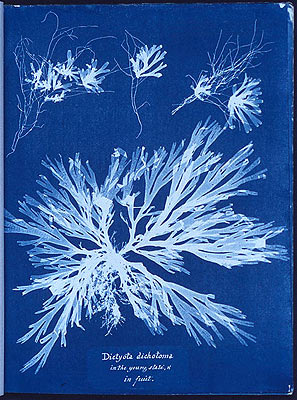
The cyanotype process was one of the get-go non-silver technologies used to create photographic images. Originated in the 1840's, it was non utilized in mainstream photography and was adopted as a copying technique, condign known by the term "design", with its blue background reproductions of big architectural and mechanical drawings.
To begin the process, two solutions are prepared for the ii-function sensitizing procedure. Fabric sensitized with the solution is then printed by ultraviolet light.
Variations of the original formula involve different ratios of the post-obit chemicals:
(1) Potassium ferricyanide and (two) Ferric ammonium citrate(light-green). Also much potassium ferricyanide in the solution will lower printing speed; likewise little may cause the blue colour to drain into the lighter areas. Basically equal volumes of the two solutions are used.
Below are several more than commonly used cyanotype recipes. The chemical names are linked to prices, data, and online ordering. Utilise advisable safe measures throughout the process.
Solutions may exist stored for several months in amber glass bottles.
Recipe #ane: This is the original created by John Herschel in 1842.
Solution A:
- Ferric Ammonium Citrate 200 gm.
- Distilled Water to make 1000 ml.
Solution B:
- Potassium Ferricyanide 160 gm.
- Distilled Water to make g ml.
Recipe #ii: Variation using more concentrated solutions.
Solution A:
- Ferric Ammonium Citrate 360 gm.
- Distilled Water to brand m ml.
Solution B:
- Potassium Ferricyanide 200 gm.
- Distilled Water to make 1000 ml.
Recipe #3: A modern variation.
Solution A:
- Ferric Ammonium Citrate 272 gm.
- Oxalic Acid 5 gm.
- Distilled Water to make chiliad ml.
Solution B:
- Potassium Ferricyanide 92 gm.
- Oxalic Acid 5 gm.
- Ammonium Dichromate ii gm.
- Distilled Water to make grand ml.
PROCEDURE FOR Press
Work Area
A fully prepared work surface area should be organized before the sensitizing procedure begins. A light-condom surface area is all-time for sensitizing the fabric, newspaper, etc. For drying, institute a drying area in a totally dark room.
Method
Mix Stock Solutions
Combine equal amounts of solutions A and B from one of the above recipes.
Sensitize surface
Soak newspaper or textile in a tray of combined solutions or apply with a castor. Exist sure to make some test strips for later on use in testing exposure times.
Dry coated fabric
Dry abroad from lite. A clothesline can be hung over an erstwhile tub or layers of newspapers to catch drips. A hair drier or fan tin be employed to shorten drying time. Dry blanket should be bright yellow.
Printing
Cyanotype is a negative process - areas where light does non hit sensitized material will remain white. Contact print by placing negative on your sensitized material. Expose to stiff sunlight or UV light until the high values are a lilliputian likewise dark and the shadows take begun to reverse. Y'all tin use examination strips to test low-cal to determine best exposure time.
Washing and Developing
Wash in running water until xanthous residual is gone from nonexposed areas. The print will still be a weak, silvery bluish. Every bit it dries it will oxidize and plow blue.
Intensification (Optional)
To brighten highlights and more fully develop the blue epitome, bathe the cyanotype print with a weak solution of household bleach and h2o (1/32) or 3% hydrogen peroxide. Subsequently virtually a minute in the intensifier bath, remove print and wash in plain h2o again for 20 to 30 minutes.
Drying
Dry finished print. Epitome will generally announced darker when information technology is dry.
Source: https://www.sciencecompany.com/The-Cyanotype-Process.aspx
0 Response to "What Materials Can a Person Use to Create a Cyanotype Image?"
Post a Comment